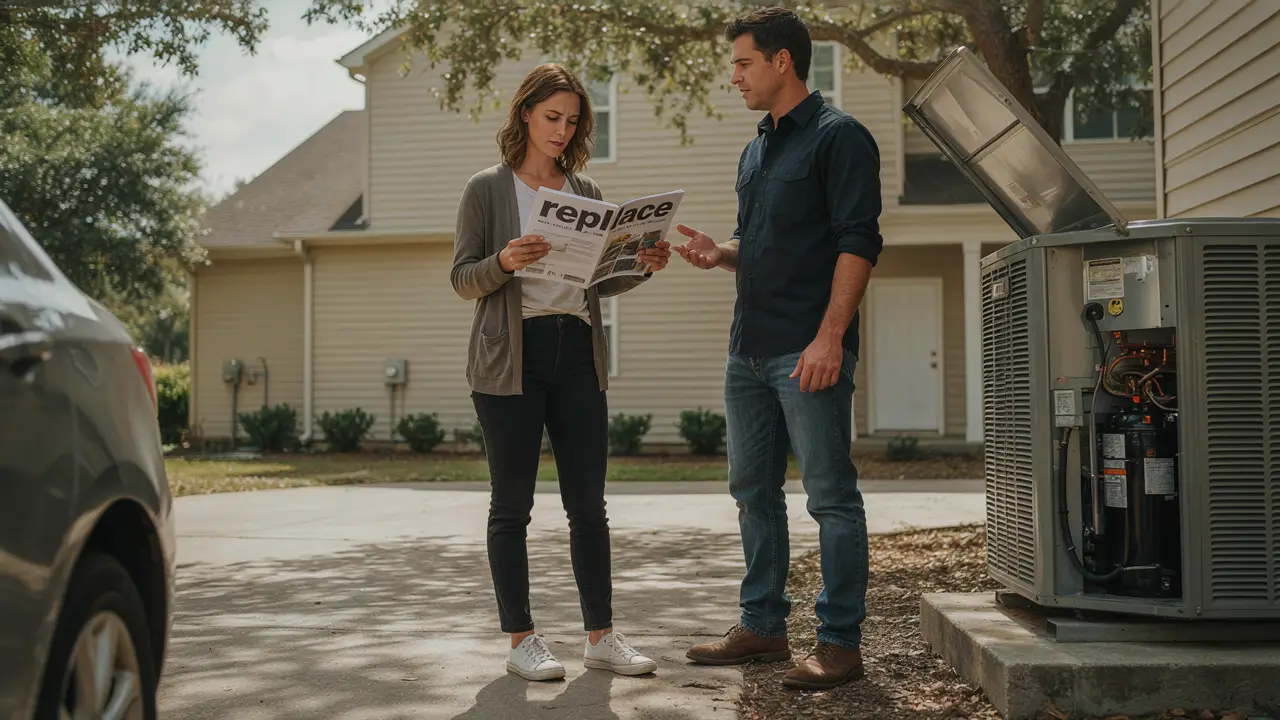
If your HVAC system stops cooling your Houston home properly, the first question is usually simple: Should you repair it or replace it?
The answer is not always “buy a new system.”
In some cases, a targeted HVAC repair can restore comfort and extend the life of your equipment. In others, continuing to repair an aging system can mean spending money on short-term fixes while efficiency and reliability continue to decline.
Understanding the difference between HVAC repair vs replacement can help Houston homeowners make a smarter decision based on the system’s age, condition, performance, and long-term operating costs.
When HVAC Repair Makes Sense
Repairing your HVAC system may be the better option when the equipment is relatively young, has been properly maintained, and the problem is isolated.
For example, a professional repair may make sense when you are dealing with:
- A faulty electrical component
- A thermostat problem
- A clogged condensate drain
- A worn capacitor
- A minor airflow restriction
- A blower or fan issue
- A refrigerant-related problem that can be properly diagnosed and corrected
A single component failure does not necessarily mean the entire HVAC system needs to be replaced.
The key is understanding why the system failed and whether other problems are developing at the same time.
A professional HVAC evaluation should look beyond the immediate symptom before recommending a solution.
When HVAC Replacement May Be the Better Investment
Replacement becomes more compelling when the system is aging, inefficient, unreliable, or repeatedly requiring major repairs.
ENERGY STAR recommends considering replacement when heating or cooling equipment is more than 10 years old, particularly when frequent repairs and rising energy bills are also becoming an issue. (ENERGY STAR)
For a Houston homeowner, several warning signs deserve attention:
1. Your HVAC system is more than 10 years old
Age alone doesn’t automatically mean you need a new system.
However, an older system that is also experiencing performance or reliability problems deserves a closer evaluation.
2. Repairs are becoming frequent
One repair is one thing.
Multiple significant repairs over a short period are different.
If you are repeatedly paying to replace major components, the question becomes whether another repair is actually the most cost-effective choice.
3. Your energy bills keep increasing
An aging or poorly performing HVAC system may require more energy to maintain the same indoor temperature.
But don’t automatically blame the equipment.
Poor duct performance, restricted airflow, insulation problems, and other home-performance issues can also make an HVAC system work harder. ENERGY STAR specifically recommends addressing duct and air-leakage problems before assuming equipment replacement is the solution. (ENERGY STAR)
4. Your home doesn’t feel evenly comfortable
If one room is freezing while another is still hot, replacing the equipment may not solve the problem.
Uneven temperatures can be related to:
- Duct leakage
- Poor airflow
- Incorrect system sizing
- Insufficient insulation
- Air leaks
- Distribution problems
This is why a complete performance evaluation matters.
5. Your system is becoming unreliable
If your AC repeatedly breaks down during Houston’s hottest months, reliability becomes part of the replacement decision.
The cost isn’t just the repair itself. It’s also the disruption, emergency service, uncomfortable indoor temperatures, and possibility of another failure shortly afterward.
HVAC Repair vs Replacement: What Should You Compare?
When deciding between HVAC repair or replacement, don’t compare only the price of today’s repair with the price of a new system.
Look at the bigger picture.
| Factor | Repair | Replacement |
| System age | Usually younger | Often older |
| Repair history | Occasional | Frequent |
| Current efficiency | Still acceptable | Declining |
| Comfort | Mostly consistent | Frequent comfort issues |
| Energy bills | Relatively stable | Increasing |
| Long-term reliability | Good | Becoming uncertain |
| Investment | Lower upfront cost | Higher upfront cost, longer-term investment |
The right decision depends on the combination of these factors—not one number.
Don’t Replace Your HVAC Before Checking Airflow
This is especially important for Houston homeowners.
A system can have a relatively serious comfort problem without the equipment itself being the primary problem.
Restricted or inadequate airflow can affect comfort and efficiency. ENERGY STAR notes that airflow problems can reduce HVAC efficiency by up to 15%. (ENERGY STAR)
That’s why a proper evaluation should consider the entire system, including the equipment, airflow, ductwork, controls, and overall home performance.
Replacing a perfectly serviceable HVAC system without identifying an underlying airflow or duct problem could simply mean putting new equipment into the same problematic conditions.
What About Energy Efficiency in 2026?
If replacement is the right choice, today’s systems can offer improved efficiency compared with older equipment.
The Department of Energy uses SEER2 as the current cooling-efficiency metric for central air conditioners and heat pumps, following updated testing standards introduced in 2023. (The Department of Energy’s Energy.gov)
But higher efficiency on the equipment label isn’t enough.
Installation quality matters too.
ENERGY STAR notes that improper installation can reduce system efficiency by up to 30%. (ENERGY STAR)
That means Houston homeowners should evaluate not just which system they buy, but how the system will be selected, sized, installed, and tested.
A Simple Way to Think About Repair vs Replacement
Ask yourself these questions:
Is the system relatively young?
→ Repair may make sense.
Is the problem isolated?
→ Repair may make sense.
Has the system needed multiple major repairs?
→ Evaluate replacement.
Is the equipment older and becoming inefficient?
→ Compare replacement costs with continued operating and repair costs.
Are some rooms consistently too hot or too cold?
→ Evaluate airflow and duct performance before replacing equipment.
Are energy bills increasing while comfort is declining?
→ A full HVAC performance evaluation is worthwhile.
The goal isn’t to repair everything or replace everything.
The goal is to determine which option delivers better comfort, reliability, efficiency, and value for your home.
Houston Homeowners Don’t Have to Guess
When an HVAC system isn’t performing, the fastest answer isn’t always the best answer.
A professional evaluation can help determine whether the problem can be corrected with a repair, whether airflow or duct issues are contributing to poor performance, or whether replacing the system is the smarter long-term investment.
At CoolTechies, the goal is to look at HVAC performance as a whole—not simply replace equipment because something isn’t working.
If your Houston home’s AC is struggling, let’s determine whether you need a repair, a performance improvement, or a replacement.
FAQs
Is it better to repair or replace an HVAC system?
It depends on the system’s age, condition, repair history, efficiency, and overall performance. A professional evaluation can help determine which option makes more financial and practical sense.
How old should an HVAC system be before replacing it?
Age isn’t the only factor, but ENERGY STAR recommends considering replacement when heating or cooling equipment is more than 10 years old, especially when repairs become frequent and energy costs increase. (ENERGY STAR)
Can poor airflow make an HVAC system seem like it needs replacement?
Yes. Duct problems, restricted airflow, inadequate insulation, and other home-performance issues can cause comfort and efficiency problems even when the HVAC equipment itself isn’t the primary issue. (ENERGY STAR)
By Calixto Armas